

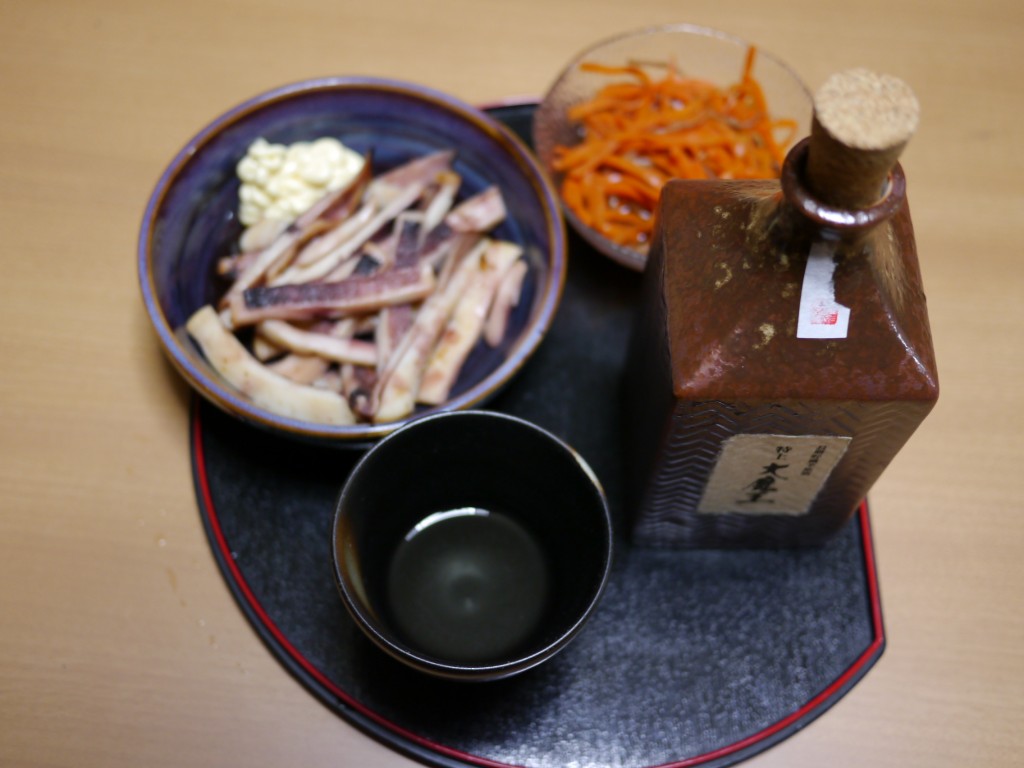
Daimaou 大魔王 with boiled squid and carrot pickle side dishes (photo: Sean O’Leary)
By Sean O’Leary
Up until a few years ago, my operating mode was: avoid indigenous Asian liquors as much as you possibly can. Tales of the sangsom/Red Bull buckets in Thailand, nights in the pojang macha (a kind of Korean street food bar/tent) in Seoul sucking down shot after shot of soju. Or, even worse, Baiju: that kerosene-tasting Chinese swill in the ceramic bottle that some genius had brought back from his travels. The worst one had to be a night in Hoi An, Vietnam where a dude who worked in the kitchen at my hotel bought me a bottle of what he called Irish whiskey in return for me teaching him a few licks on the guitar. I remember it being called something like Irish Whispers, or something like that. Aptly named, if an Irish Whisper is slang for some dude named Seamus kicking you in the back of the head 60 times. I guess the “Made in HCM, Vietnam” should have been a warning sign. For a while after some of these horrific experiences “Made in Asia” was a no-no. Any amount, one shot or 30, and I was poisoned.
The thing is, in my time getting used to different kinds of local liquor, I’d always started with beer, and that’s danger. Dead sober, I get offered a shot of something and I turn it down. Three to four beers in, I’m more suggestible, and the results are always bad.
The idea is not so much to avoid these things but to consume them correctly. It took me about nine years of living in Asia to realize this, and the magic elixir that brought me to my new outlook was the shochu varieties Japan has to offer. After being somewhat bullied into drinking it straight, no chaser at the behest of my father-in-law, I came to realize the combo of beer and Asian liquor was the problem, not the liquor.
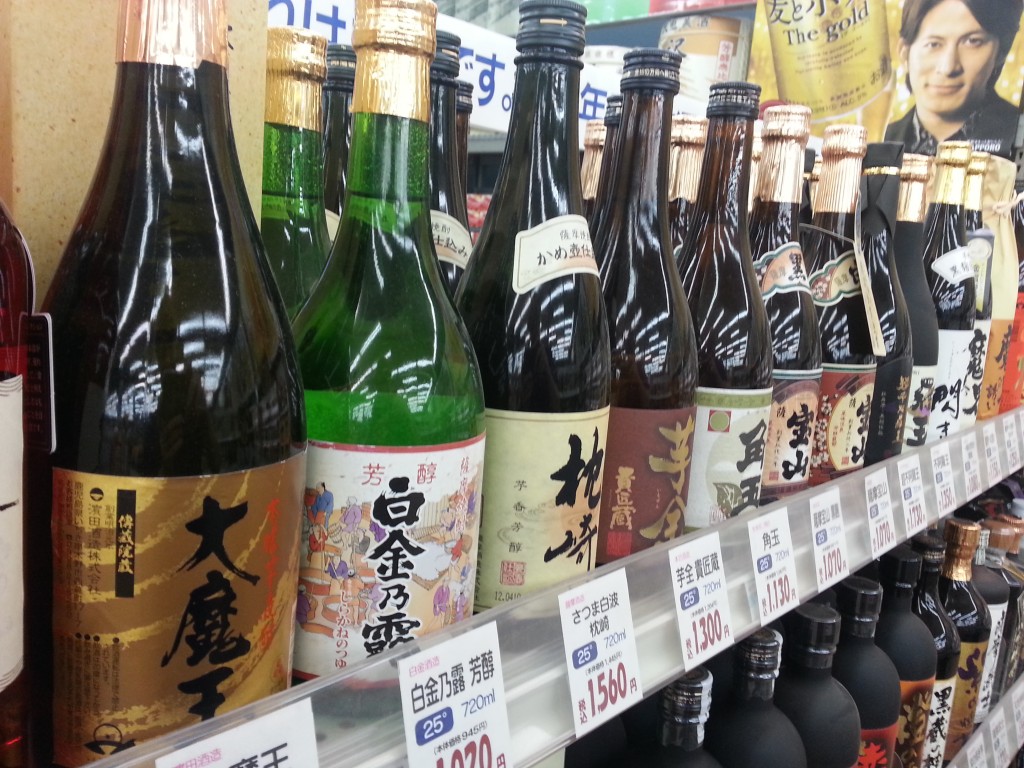
A rack of mid-range shochu, running around $20-$30 Canadian (photo: Sean O’Leary)
We all know Japan as the land of 酒 (sake) somewhat of a misnomer because 酒 just means “alcoholic beverage” and is more of a legal term than a drink you get at the sushi bar. 日本酒 (Nihonshu,) what we commonly refer to as sake, is the rice wine that runs around 13 to 17 percent alcohol. I’m not a huge fan. Nihonshu enjoys much popularity here but the market for powerful and delicious grog is tipping in favour of Nihonshu’s distilled cousin, 焼酎 (shochu), or, literally, fire liquor. Fire refers to the distilling process itself, but the fact that its name has the word fire in it is quite poetic when remembering red-faced nights of stupidity.
Three common varieties take up the majority of shochu sales: 麦 mugi (barley), 芋 imo (potato/sweet potato), 米 kome (rice) and, less so, ゴマ goma (sesame), 黒糖 (brown sugar) and そば soba (buckwheat). They average around 20 to 25 percent alcohol, with a few varieties getting up around 30 to 40 percent. I’m most fond of potato, as it’s a warm, happy drunk with a noticeable lack of hangover that increases with the price of the shochu you buy. I personally find the potato stuff clean tasting and floral, with barley and soba being quite fruity, to the point of me worrying about how I’m going to feel the next day.
Shochu is drunk straight, rocks, with water both warm and cold, and as a chu-hi, a highball of maybe two ounces of ‘chu, with a combo of fruit juices, often yuzu (a Japanese citrus much like a bland grapefruit), or with Oolong tea. Soda water is also commonly used for a chu-hi. One of the most regretful mornings of my time in Japan was when a local Izakaya chain offered 100 yen chu-hi on a Sunday evening when we all had work at 8 am the next morning. However, the chu-hi is generally reserved for cheaper shochu like Triangle or Big Man. Bigger liquor companies produce canned chu-hi, which is almost always cheaper than a beer, and quite a delicious, quick drunk, though I almost always feel like I have a mild flu the next day.
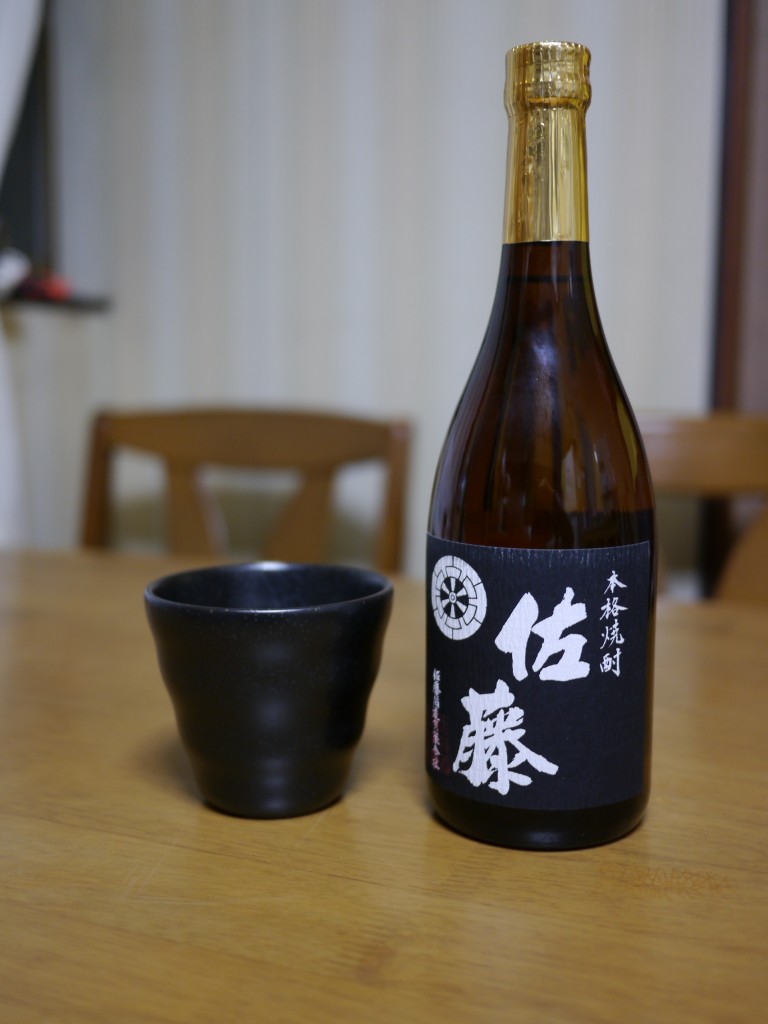
Satou Kuro 佐藤黒 and a standard shochu cup (photo: Sean O’Leary)
For the purposes of this article my wife, Maiko, let me throw down about 30 bucks on a nice bottle of 大魔王 (Great Demon King,) a 36 percent potato/rice variety brewed in Kagoshima Prefecture, Kyushu. Production of sweet potato has been one of Kyushu’s main industries since the Edo period, so it would also make sense that the best potato shochu also comes from here. Like microbreweries in any Western country, or Scotch in Scotland, or the Bourbon Route in Kentucky, you can tour Japan on Nihonshu or Shochu. Tonight I’m in Kagoshima and the weather is smooth and warm with 100 percent chance of drunken.
Let’s get back to that name: Great Demon King. Shochu names are often hilariously over the top. The same way a microbrew may try to put some kind of hokey name like Tin Whistle Pale Ale or Willow Fence E.S.B., the Japanese market tends to go for two basic themes 鬼と魔 (demons and hell) or sentimental stuff about old Japan.
A few names that I find cool:
魔界への誘い Makai he no Sasoi – Invitation to Hell.
ダディー、待ってたよ!Daddy, Matteta Yo! – “Daddy, I Was Waiting!” (“…for you to get home from work, here’s a drink, put your feet up!” is the implied meaning, I guess).
黒霧島 Kurokirishima – Black Mist Island.
魔王 Maou – King of Hell (I’m not sure if the constant “hell” references are referring to the possibility of a brutal hangover or some spiritual nonsense).
クジラ Kujira – Whale (long heralded as a symbol of strength and also as a source of meat).
里娘 Sato Musume – Hometown Daughter.
天孫降臨 Tenson Kourin – Return of God(ess)’s Grandchild (refers to a legend of the sun goddess, Amaterasu).
金時一刻 Kintoki Ikkoku – Kintoki is a variety of red potato, but the use of ikkoku suggests that the shochu is made by a stubborn person.
For the purposes of further educating myself, Maiko ordered me to drink it straight with hot water, one of the ways old Japanese guys do it. This particular variety was 原酒 (genshu), which could be loosely translated as single malt, in much the same way we classify whiskeys. It had a sweet, floral taste on first (straight) shot, with a deep, somewhat smoky afterburn that was brought out when mixed with hot water. Quite agreeable, very drinkable and the drunk felt relaxing, warm and huggy. I got through about half of the bottle and was ready for bed. Morning came and I felt few ill effects.
Test two came with 佐藤黒 (Sato Kuro, or Sato Black), another famous premium potato variety from Kagoshima that ran me about $50. First taste test with this one gave me almost nothing; it was like drinking air, with a little hint of alcohol. Now add some hot water and the flavors come out. Imagine the lightest tasting vodka with a slight, barrel-aged feeling. Aftertaste? Nearly nothing. The kind of thing that you would maybe write off as boring, but it’s anything but boring.
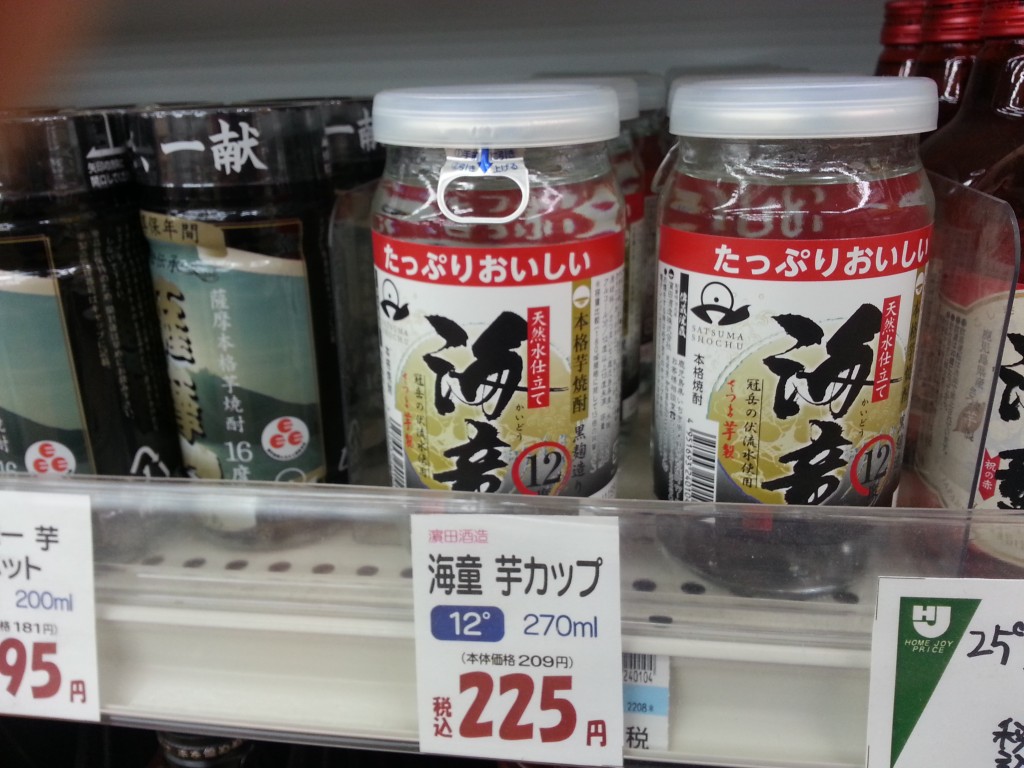
Cheap cup shochu that runs about 200 yen ($2 Canadian) (photo: Sean O’Leary).
I liken the difference between these two tastes to being like the difference between two different scotches, with the 大魔王 (Daimaou) being like Lagavulin or some other challenging super-peaty Islay variety, and the 佐藤黒 (Sato Kuro) being much like Oban; light, clear and easy on the palate. Or like the difference between Stilton cheese and emmenthal. Compare these two tastes with some of the other ones I’ve had, i.e. the 1000-yen-a-bottle kind like Kurokirishima and Shiroba, the kind you need to mix with something just to get them down, mostly because of the very dominant alcohol taste, and you’ll see that spending a few bucks on a decent bottle is worth it. The floral, steeped-with-roses (though not actually steeped with roses) flavour of 赤兎馬 (Sekitoba) can be had for under 2,000 yen/bottle, and that’s a lot of flavour for your buck.
The sad fact about putting these words down is that they’re bound for a Western audience, and a quick look at the BC Liquor Distribution Branch website (the branch that governs alcohol in British Columbia, Canada) shows that a real bog-standard variety of mugi shochu, Iichiko, is available, along with another that’s produced in Vietnam. The price in my local drugstore? 800 yen, or roughly $8.50 Canadian. The BC liquor store has it listed at $40. So, while your interest may have been piqued by what I’ve said, import costs dictate that it’s going to be a long time before premium or regional varieties are going to be affordable in most necks of the woods any time soon.
All the more reason to book that trip to Japan you’ve always wanted to take.





No Comments