

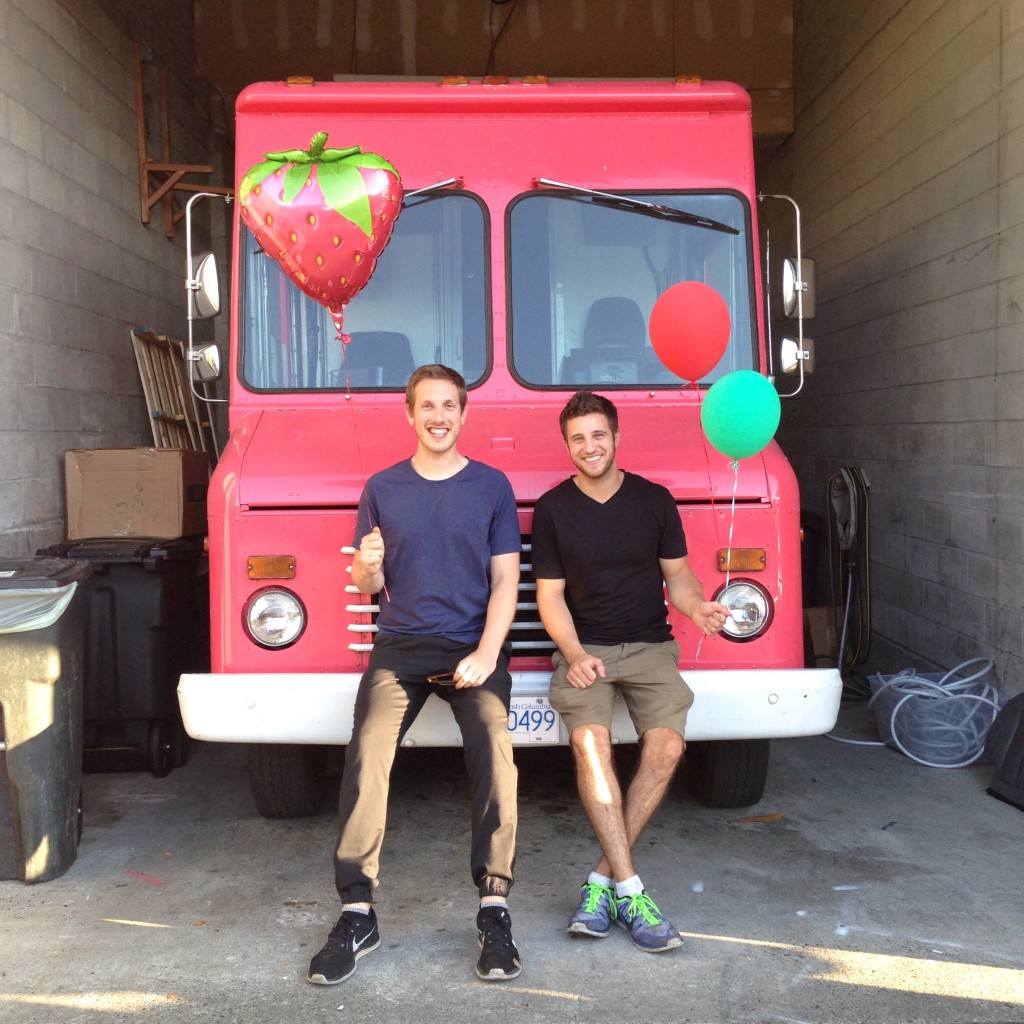
Zach Berman and Ryan Slater (photo: Heth PR)
By Megan Cole
If Vancouverites aren’t complaining about the weather, they are likely going on about the newest cleanse. Cleanses never really seemed all that appealing until the word juice was added to the mix. In the past three years, juicing has gone from being a celebrity fad to a part of everyday life for many health-conscious people. While many are following the trends, Ryan Slater and his business partner and best friend, Zach Berman, have a way of staying ahead of the curve.
Slater and Berman are the owners of The Juice Truck, which opened its storefront location about a month ago. Even though food trucks are now a popular part of the Vancouver landscape, The Juice Truck didn’t jump on the bandwagon. In fact, Slater says they were pioneers.
“We were part of the first round of the start of the food cart trend in Vancouver,” he says. “We launched, I think it was July 2011, and when we launched there were seven or eight trucks, and now there are over 100. I consider us to be part of the pioneers of the food truck business in Vancouver.”
It’s surprising how tuned in to the trends Slater and Berman were when they launched their blooming lifestyle business, considering the idea of The Juice Truck came to them far from the streets of Vancouver. The pair, who have been friends since they were nine years old, were backpacking through India, Nepal and Sri Lanka when they began a juice journey.
“We were doing a trek in the Annapurna circuit range in the Himalayas,” says Slater. “We were snowed in at a village and we couldn’t continue on. While we were there we saw all the locals were drinking an orange coloured juice.”
The orange juice was a Himalayan superfood called Seabuckthorn, which provided a large amount of the village’s nutrients, including Omega 3s and 6s, because there was limited fruits and vegetables grown at that altitude.
“We were so intrigued by the concept of a juice we’d never heard about with important medicinal benefits for these communities, and for the rest of our trip we made it our mission to try as many juices as we could,” says Slater.

The Juice Truck storefront location (photo: Heth PR)
Throughout India the pair drank juices at the popular juice bars, which reminded them of the coffee shops they’d left behind in Vancouver. Up and down the streets of India, people would meet and hang out with friends over a juice.
“The juice bars were everywhere,” says Slater. “Because we spent the whole year trying juice, when we got back to Vancouver we knew we wanted to do something juice-related. The food-truck movement was kicking off in New York and LA, and the juice industry it had just started, especially in LA, so we decided we would take those two and mold them together to create The Juice Truck.”
In case starting the first juice food truck in Vancouver wasn’t enough for Slater and Berman, they decided to embrace cold-pressing, which is considered to be the best technology for creating juice with high levels of nutrients and enzymes.
Armed with a juice-focused food truck and their cold press, The Juice Truck became Canada’s first real cold-pressed juice company, and are still one of a handful of businesses producing cold-pressed juice per order.
“Most companies bottle behind doors and sell the juice in bottle form,” says Slater. “Our point of difference, and it really showed at the beginning, is cold-press really is the best form of juicing and we were doing it in the best way possible. It really set us apart.”
While a lot of us may have juicers at home, Slater says the cold-pressed method extracts the enzymes and nutrients of the fruits and vegetables at a higher level than the common centrifuge juicer.
“The two biggest things that destroy live enzymes and nutrients in juice is heat and oxidation,” he says. “The juicer that most people us are centrifuge juicers. What those do is spin the fruits and vegetables at a really high speed. As it’s spinning it’s separating the juice from the fibre, but as it’s oxidizing.”
The spinning of the blade on the inside of the juicer also generates a lot of heat, which can eliminate some of the nutrients and also means the juice has to be consumed right away, but with cold-press Slater says they are able to bottle their juices for up to 72 hours.
But it isn’t just juice and business for Slater and Berman. Inspired by the great lifestyle companies of the world, like outdoor clothing company Patagonia, the duo wanted to go beyond making great juice for their health-conscious customers; they also wanted to give back to the community and neighbourhood that was now interwoven with their brand.
When The Juice Truck opened the doors of their brick-and-mortar location, they included a community space where they invite the community in to learn more about healthy living from other experts.
“We offer weekly nutritionist workshops, weekly yoga classes, along with health seminars and movie nights,” says Slater. “For us we always wanted to create a hub for health and wellness in the city. Community outreach was so important for us when we launched because the truck is in the Downtown Eastside, in Gastown, and we understood what it was like to engage with the community and give back. The community space was our way of being able to engage in new communities and give back. It’s like when people think of companies like Patagonia, they think of the lifestyle associated with the brand, so with the juice comes a healthy lifestyle.”
The Juice Truck is located in Vancouver, BC at the counter of Water and Abbott Streets, and their new brick and mortar location is at 28 W 5th Avenue


No Comments