


Nick Fauchald
Interview by Megan Cole
With Food & Wine Magazine, Wine Spectator, Every Day with Rachel Ray, New York Times, and Gilt Taste on his writing resume, amazing food-related things are to be expected from Nick Fauchald, and the Short Stack Editions are no exception. They may be small, but these little cookbooks are evoking a love for a style of cookbooks that was at its best during the mid-century. Despite the leaps and bounds into the future, Fauchald is part of a growing trend that reminds us that cookbooks, the way our grandmothers used them, are here to stay. And even though Fauchald spent many years creating food-related content for the digital world, he still loves the feel and experience of flipping a cookbook page. We talked to Fauchald about Short Stack Editions, why print reigns over digital when it comes to cookbooks, and what he’s been listening to in the kitchen.
How did you come up with the idea for the Short Stack Editions?
I started off working in print journalism and worked in magazines for about six or seven years. My last magazine job was at Food & Wine. I left to start an online publication called Tasting Table, and that consumed the next few years of my life. I left to do more digital projects, consulting, and apps, and all these digital things, and after a while of that I started missing working on print products and tactile, tangible things. I was looking around for a project I could do that would satisfy that yearning, and I have always been really interested in these recipe pamphlets that food brands put out back in the ’40s, ’50s and ’60s. They were used as marketing collateral and often given out with products or appliances. If you bought a GE stove, you’d get this little cookbook with it. The design of those was always intriguing to me because it was mid-century design.
Did how we cook now, compared to in the past, impact your decision to start your next project?
The fact that these days we get more inspired by ingredients than we used to definitely came to mind when creating Short Stack Editions. Ten or 20 years ago, if you were going to cook dinner you probably wouldn’t start by going to the market and looking at the produce aisle, or going to the farmer’s market and picking up a nice piece of broccoli. Instead, you would probably think about what kind of fish you wanted to make, or what ethnicity you wanted to cook. These days, you would make those decisions after you shop, which is great, and that is how I cook, and a lot of my friends cook. But a lot of publications and cookbooks don’t serve that type of cooking well. When you talk to your friends and ask them what they cooked last night, and you ask where they got that recipe, or what gave them that idea, they will often say they went to Google and typed in “broccoli recipe,” looked at a few things and cooked what looked interesting. We wanted to create the analogue version of that, so instead of going to your computer, you’ll pick up one of our broccoli books instead to get ideas.
What do you think is lost in food publications, between digital and print formats?
A couple of things. I was really optimistic about digital cookbooks and recipes. I started making cooking apps and publishing e-cookbooks, and it works really well. But I think I got ahead and a little too excited, as have other people, and I realized we like having something in front of us that we can turn the pages and make notes on, and iPads and computers just don’t do that. I think the reason why cookbooks continue to do well, even when all others categories of print books are on the decline cookbooks are still holding steady, and it’s because we like to hold them in our hands. And I think when you are going to a computer or another device the experience of finding a recipe is really a narrow, kind of tunnel vision one. With a cookbook, just the fact that you can flip and browse through it is just a more rewarding experience for people.
What is the process that you go through to select the ingredient for one of your editions?
They all start with the authors themselves. We work a lot with people that I have worked with in the past. A lot of our authors are recipe developers, or work in test kitchens at my favourite magazines or publishing houses, or they are cookbook authors themselves. Very few, if any of them, are well-known named chefs. We’ve had a couple restaurant chefs in the mix, but they understand home cooking and write cookbooks for home cooks as well. Once we find someone whose recipes we love, we let them pick their favourite ingredient. What is the thing that’s indispensable to them? Or the ingredient they are always most inspired to cook with? That’s usually a pretty easy choice for them and that’s how we get to it.
They almost remind me of those Time Life cookbooks that came out with all the specific ingredients. Short Stack Editions is like the modern interpretation of that.
My life dream is resurrect that series, and remake that series in one way or another. This is kind of an homage to that, but I consider those Time Life cookbooks as one of the most important cookbook series ever done. I hope that comes back.
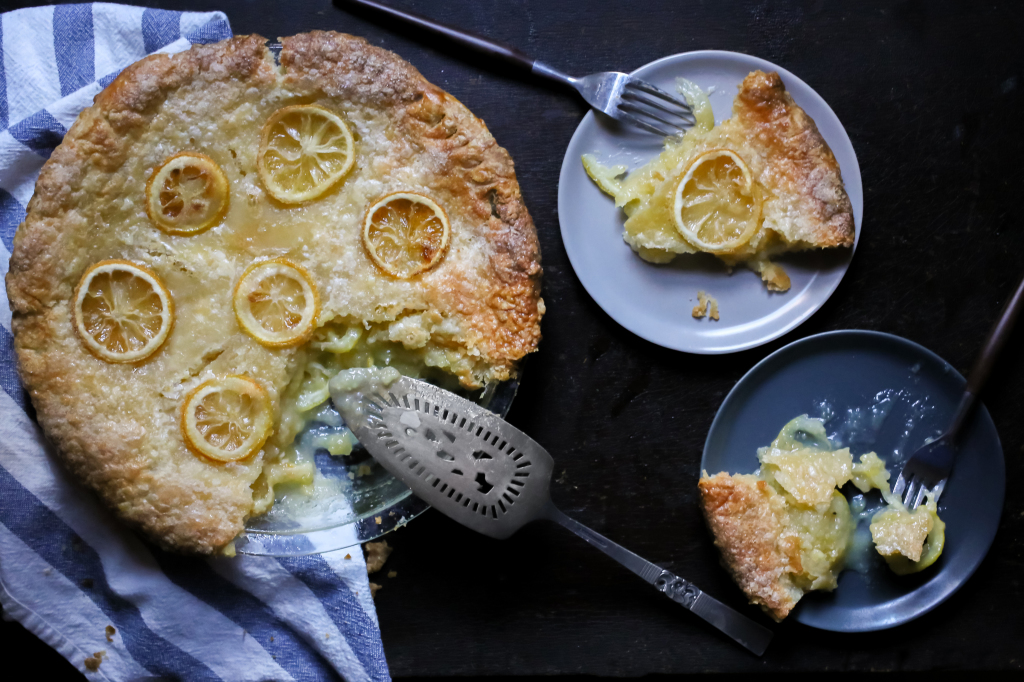
Lemon Shaker Pie (photo: Mackenzie Smith)
What are some of your favourite recipes that you’ve featured so far?
Oh gosh! Because it’s really fresh in my mind, our new book, which is coming out in a week or two, is all about lemons. The author of that book works in a test kitchen at Bon Appetit Magazine. And before I even knew her, and talked to her about doing a book, she always did really interesting things with lemons. I learned to roast lemons along with vegetables, basically she puts lemons with everything. She taught me that you shouldn’t just consider them so much as a fruit, but as an essential ingredient like salt, pepper and olive oil, and things that are totally necessary. I have been cooking mostly out of that as well. Right now in the winter, I have been eating a lot of broccoli, so I’ve also been cooking a lot out of our broccoli book. And our first book on eggs has given me a lot of new standard recipes.
We’ve talked a lot about indispensable ingredients in the kitchen. Do you consider music to be as important?
For me, absolutely. I love to have music playing when I’m kitchen.
What do you like to listen to?
It depends on the mood and who I’m cooking with, but lately I have been on a Fleetwood Mac kick, because they’re touring again, and I’ve been seeing their shows. I have a bunch of old Fleetwood Mac albums, like their bluesy stuff, and I’ve been listening to that. Before that I was listening to a lot of War on Drugs, which is great. Any album that’s really good start to finish, like a real album, is what I like. I want to just put a record on, or put an album on my computer and go straight through it. I don’t have cooking playlists; I like the experience of listening to a full album when you cook.
A lot of people who enjoy spending time in the kitchen enjoy music along with that experience. Why do you think cooking and music go together so well?
I don’t know. I have cooked in kitchens where music was forbidden, and I have cooked in restaurant kitchens where music was part of the process. The difference in the mood and energy in those two settings is completely different. The reason we listen to music while we workout, or study, or anything else, is that it keeps our minds active, focused and keeps us motivated. All the reasons that I have my headphones on at the gym are the same reasons I have music on in the kitchen.
Nick Fauchald‘s Short Stack Editions are available through their online store.





No Comments