

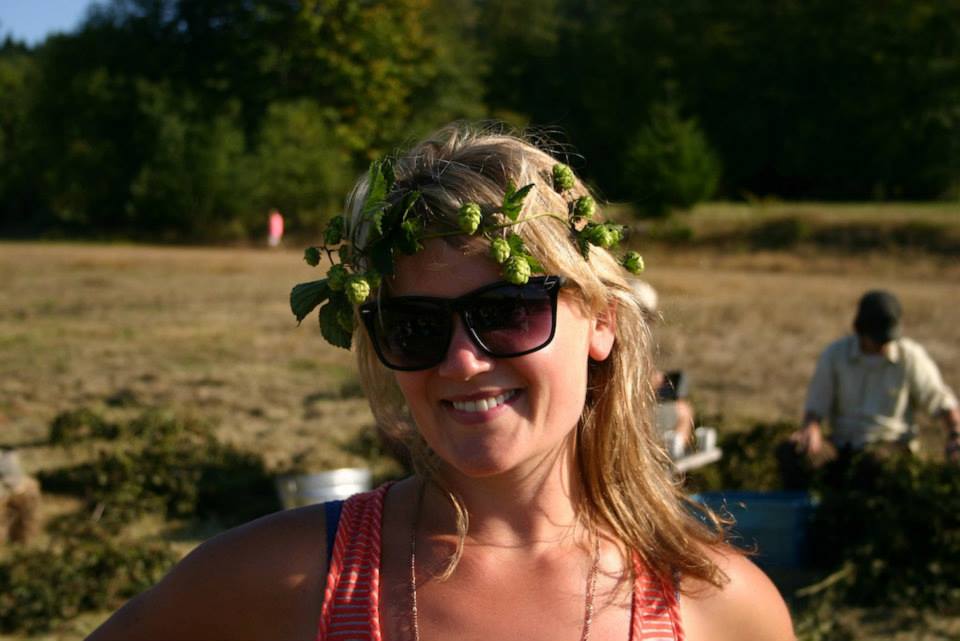
Becky Julseth of Saltspring Island Ales
Interview by Megan Cole
It’s safe to say that craft beer isn’t just a product; it’s a revolution. It’s not only changing the way people drink beer, but also the way it’s being marketed, and even who’s making and selling it. Women, who traditionally weren’t involvement in breweries, are increasingly choosing craft beer over the typical wine or cocktails and, like Becky Julseth, owner of Saltspring Island Ales on Saltspring Island, British Columbia, they are also becoming brewery owners.
Tell me the story of Saltspring Island Ales. How did you end up owning a brewery?
My husband, Neil Cook-Dallin, and I have owned the brewery since 2008. The reason there’s a brewery on Saltspring Island is that there is a spring on top of this 15-acre property. My husband’s uncle, his name is Bob Ellison, had a water business on Saltspring and he ran that, basically filling people’s cisterns and delivering people’s water, and he did that for years and he eventually partnered with a brewer named Murray Hunter, and they started a brewery there. That brewery ran for 10 years and they really struggled with it. It was super tiny and they barely took it off Saltspring Island. We were going to help Bob sell it because my background is mostly in real-estate marketing, and my husband is a graphic designer. We had done a lot of prospectuses to help people sell large ventures and we were going to help him do that, but we fell in love with the business as we went through that process. I told my husband we could do it because we had the skills the business needed and we both are totally food, beer and wine lovers. It was a way for us to step out of being just appreciators of craft products and local food, to being producers, which is a dream we’d both had, whether it was going to be a restaurant or something else. It went from something we were helping Neil’s uncle offload to something we fell in love with, making us producers ourselves.
How were you first exposed to craft beer?
I just turned 35, so as I became the age of drinking craft beer exploded a little bit. I think I started drinking craft beer as it was available when I was younger, but as it became more available I started trying new beers that were coming on the market. For me, it wasn’t something I made a choice to drink; it was more like all of a sudden there were all these products available and they were fun to get into and explore. It was general interest in new products that got me into craft beer.
What is it like being a woman in the craft-beer business?
I would say I bring more of a young business person’s perspective than a woman’s perspective. I entered this business when I was 29, and I just feel like my generation doesn’t put up with a whole lot of gender bias. We don’t think about being a woman in the beer industry that often. I guess it’s a luxury our moms and grandmas earned for us. I feel way more like an entrepreneur than a female business person. That is kind of why this industry is unique, because it is a bit behind.
Is the craft-beer industry different because people have to make a comment that there are women in the industry?
The fact that you even have to think about being a women in the beer industry shows the business is behind. There aren’t that many industries where that’s even a consideration anymore. It’s sort of interesting that way. What I would bring to the industry as a woman, is I know how not to market stuff to women. I feel like a lot of breweries are still feeling that out, maybe that’s because they don’t have a lot of women working for them, but things that seem fairly obvious to me, there is a whole market out there and woman are consumers just like guys. Maybe don’t market beer like you’re selling triple-blade razors or something like that. A craft brewery needs to make their product appeal to everybody, that just seems obvious to me, but maybe it is because there is a hangover of beer being marketed primarily to men. If a brewery didn’t have a woman in the business, you may not think about it.
Why do you think it is taking so long to include women in the beer world?
It’s funny to think about because I think it starts with the big, commercial breweries because they haven’t marketed beer to women. Through prohibition, beer went from being a craft product; there were little breweries everywhere, including Victoria, BC. Then through prohibition they were all shut down. After prohibition and going through the Second World War, so many products became heavily industrialized; all of the craft was sucked out of beer and it became a highly industrialized thing. Small breweries evaporated and as a product we were left with this bland macro lager. It was basically a generic beer and they marketed it as an everyman’s or a working man’s beverage; something you would pick up after a hard day’s work, or you enjoy it with your man buddies in the wilderness or something. I think the way it was industrialized and marketed is why it wasn’t appealing at all. It didn’t taste that great, so they probably had to create a story or a mythology around the product in order to sell it because the taste wasn’t selling itself.
How do the marketing techniques vary when it comes to women?
Think about it how many products are marketed to one specific gender; the only thing I can think of is maybe Crystal Light in the ’80s to aerobics women. It’s such an odd phenomenon that you would have a consumable product marketed to one gender; it’s just so strange. But I think after prohibition and after industrialization of beer, the beverages that were marketed to women, with powerful and strategic campaigns targeted to women, were wine and cocktails. It’s more about dollars spent, or not spent, on marketing than women actually not liking beer.
Why do you think women are becoming interested in craft beer?
If we look at beer now there’s an ever-increasing array of flavour possibilities. If you go to a cold beer and wine store or liquor store now you’re looking at a shelf with Belgian beers, powerful IPAs, fruit beers, Bavarian pilsners, and all being made by local brewers. It’s not one type of bland macro lager in five different cans. Craft beer itself is appealing to a broader and broader consumer base every day. Craft beer increasingly ceases to market itself as gender-specific because breweries like us know that’s a pretty silly thing to do from a business standpoint. Why would we exclude half of the marketplace? It’s dumb. The products are better, so you can rely on the craft products and flavours, or people who are buying it because it tastes good, or they can pair it with food or cook with it; they aren’t buying it because of their gender.
Saltspring Island Ales is located at 270 Furness Road on Saltspring Island, BC.





No Comments