


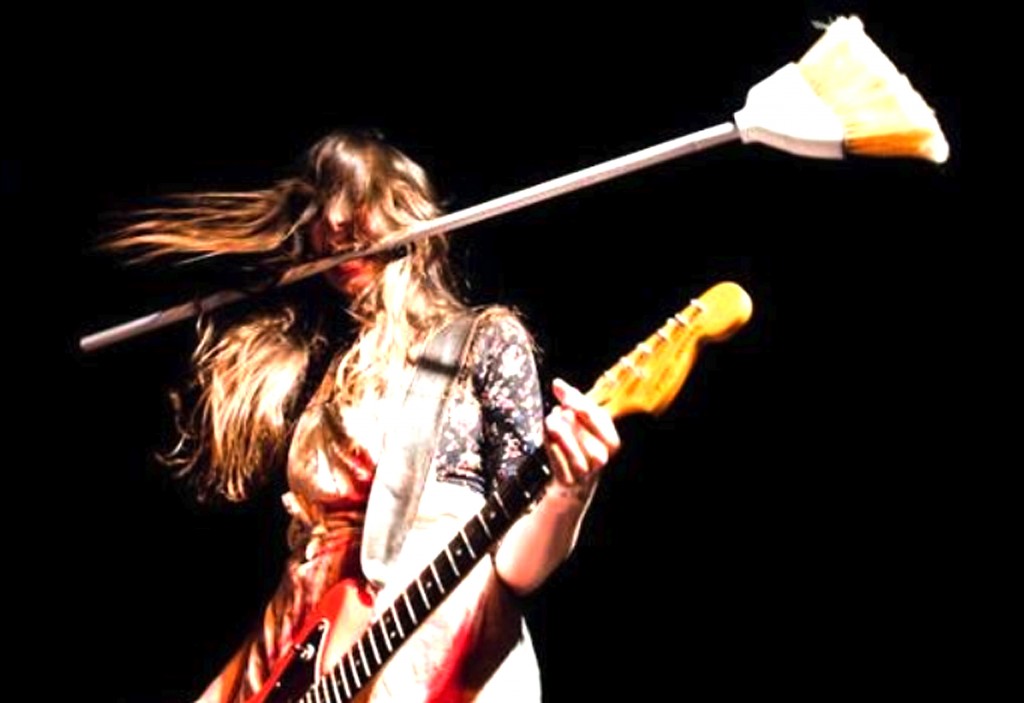
Teri Gender Bender (photo: Jason Schreurs)
When we saw Teri Gender Bender (real name: Teresa Suárez) perform last year with her band Bosnian Rainbows at a huge festival in Victoria, BC, she stole the show with her performance. Singing trance-like onstage, she suddenly climbed down into the audience, crawled around on her hands and knees around the festival grounds, stopped to dance crazily with someone in the crowd, then balance-beamed around all of the stage barricades and dove right into the arms of a security guard, who hauled her back onstage.
Suárez is a performer as unpredictable as Mike Patton or PJ Harvey, and that’s high praise indeed. With a new album from her other band, Le Butcherettes, on the horizon, including guest spots from Henry Rollins and Shirley Manson of Garbage and released by Patton’s Ipecac Recordings, the name Teri Gender Bender will surely be on the tip of a lot more peoples’ tongues very soon.
We recently caught up to Suárez and talked to her about her interesting upbringing, her love for performers and artists, and how and why she gets into that live-performance zone that has her doing things she’d sometimes rather forget.
You must have had a very interesting childhood, with your parents’ background. What kind of things did you get up to when you were a kid?
Well, I grew up in two different cultures. I was born in Denver and I lived there the first 12 years of my life until my father passed away. So when I was living in Denver, every summer after school was over my mother would take me to Guadalajara in Mexico, where all of her family is from. But when my dad passed away, my mom had no reason to stay in Denver anymore, because it was cold, and the people were very cold as well. In Mexico, you say hi to people with hugs and kisses on the cheeks, so my mom yearned for that human contact again. So we went back to Mexico and, at first, it was a cultural clash, because my Spanish wasn’t 100% Mexican because my dad was from Spain, so I had a bit of a Spanish accent and I was picked on at school. At some point I thought, “Wow, I’m alienated wherever I go.” In Denver I was made fun of because I spoke Spanish, and in Mexico I was being made fun of because I speak English, and I thought, “This is insane. What am I going to do?” So that’s when I started taking out my rage in music. I was listening to Bikini Kill, a lot of The Beatles, Cream, L7, and then Violeta Parra, a great writer, poet and painter from Chile, who was a huge inspiration. And also my mother; my mother used to be an actress when she was younger, so just seeing her live on a daily basis, and the way she is offstage; she’s just a character in of herself. When she speaks to me, it’s almost as if she’s singing opera.
How did you come across bands like L7 and Bikini Kill in Guadalajara, because that stuff was hard enough to find in North America
It had a lot to do with me trying to rebel and be different, because everyone around me was listening to, I don’t even know what they were listening to… and I didn’t identify with what kids my age were listening to, so my dad helped me a lot. In Denver, he listened to all kinds of music. He introduced me to the Pink Floyd when Syd Barret was in the band and his story was very interesting. I guess I was a sucker for tragic stories and there are more tragic stories in the world of art. I was really interested in what writers and artists had to say, and how they felt. And one link opens a link to another artist, and it’s all connected in a strange way. The Beatles somehow got me connected to Bikini Kill. It’s weird.
Do you remember when you first realized, “Hey, I can do this!” When did your eyes first open up to the possibilities of playing music yourself?
Ever since I was very little, I would always sing in the shower, and then I’d take a brush and run around my house naked with it against my mouth, singing. My mom would always say, “Oh, Teri! You should just join a band because you are driving me crazy!” One day I was skimming through the channels on TV and there was an interview with [Garbage vocalist] Shirley Manson and she said, “If I can do it, anyone can do it,” and her words resonated in my head and I thought, “She’s right! Anyone can do it. It’s just music at the end of the day.” I really believe that; it’s like the quote, “There was a bird that sings, but his singing came first, and then the bird.” So the words or music are already there, you just have to be born to tap into those words, or the music, or the cooking. My daddy was a cook and he’d always say, “Oh, the food was here; I was just born to serve it.” So I think we’re all just servers of the arts, in a way.
A big part of what you’re known for is your live performances, so I’m curious which live performers you remember being inspired by when you were starting out?
Oh, a ton. I never got to see Joan Baez, but I remember my father saved up to buy a ticket for her show for himself. He worked at a prison kitchen, so he worked a lot, and this one time he treated himself to a night out and he went to see Joan Baez. He came back and he was just in awe and he explained to us what a great musician she was, and what great elegance she composed, even though she was just wearing shorts and some sandals, and no makeup whatsoever. So just the way that he described her to me, that gave me a huge impression of, “Wow, I want to do that!” Also, the Spice Girls! That was amazing for me at the time because I went with my dad and we got seats where we could see it all, and I loved them. They were my everything! The day I found that Posh Spice got pregnant, I cried my heart out because I thought she was going to die [laughs]. In then in Guadalajara, when I started going out to little rock shows in abandoned buildings, mostly girls would go to these things because they wanted to rebel against their families because they wouldn’t be allowed to leave their houses, and these small bands would let it all out. It was good; I made a ton of good friends just going to those little shows.
Is part of what you do on stage a way of rebelling against the boring rock bands that just stand there stiff and play their music?
Oh no, on the contrary. I get mad at myself when I can’t stay still. After a show, it’s always a blur, like, “What the hell did I do? Damn it, I should have just stayed still and focused on singing!” So I wish I could stay still. I’m 25 now, so maybe it’s just a matter of age and getting older, and learning to conquer that movement. I’d like to just stay still and sing, but something gets inside of me and I can’t control it. It’s like a fly; you can’t stop the morphing of that animal, so it’s like, “Oh god, I’m turning into this thing. Aaah. Oh well.”
Teri Gender Bender with Le Butcherettes
Have you always performed like that, or is it something that you developed over the years?
I actually think it’s coming down. It used to be a lot worse. I wouldn’t even think of my safety. I’d climb rafters, jump from rafters onto people. During the swine epidemic in Mexico, I’d just lick peoples’ hands in the audience for no apparent reason. This is what people tell me; I’ve seen pictures of it, but in the moment, it’s all a blur. It’s like something else is in you. I know that sounds super cliché and corny, but that’s the best way I can describe it. Sometimes I would incorporate broomsticks, because it’s like the 1950s suppressed housewife; we’d cook cakes onstage. But now it’s a lot more calm, I feel, and I’m getting a lot less bruises, so that’s good.
Do you sometimes worry that if that element of your show subsides over the years, that you’d lose a part of what you do?
Yeah, exactly, but you want to find a way to reinvent yourself. You don’t want to be stuck to the same old schtick.
What gets you into that zone? Is it when the music starts that you get into it, or does it take something to happen during the show that sets you off?
I think it’s probably the nervous energy. It has to be the adrenaline. Adrenaline is a big drug. Some people think that I take drugs before going onstage, or that I get drunk, but I don’t even do any of those things. I’m very boring. So, it’s all due to the adrenaline, because I really feel like I’m about to die before I go on stage; I get so nervous and I sweat a lot, but I try not to tell anyone that I’m nervous because then it becomes real. So I hold it all in and then I feel drunk; I naturally get drunk with my nerves, so I guess that’s why it happens.
What was it like working with Henry Rollins on “Moment of Guilt” on your new album?
Super amazing. I’ve always been a big admirer of his and he was just really open to it. He’d always been supportive of Le Butcherettes, and I’d never gotten a chance to thank him, so I took advantage of that and asked him to please be part of this album. I know he doesn’t do music anymore, but he likes to write and he’s a great writer, so I said, “Why don’t you write something around the theme of guilt.” That’s what the album is based on, and I told him a little about coming from Mexico and that I felt guilty because I felt like I was leaving behind a big part of me by going other places. So he wrote the story of a man and the personification of guilt, talking together, and I thought that was really empowering because at the end of the day, you define what gets you, or what gets to you. So it was really awesome what he wrote based on the theme of the album.
Do you find when you write your songs and lyrics that you go into that same zone as when you perform? Do you lose control of yourself and it comes pouring out, or do you really have to work for it to come?
It’s weird, because I can do that when I’m in the closet or the car; that’s where I write mostly, and it comes pouring out. I travel with a cassette recorder that my dad gave me, and I feel like I have him next to me and I feel like he’s listening to me. When he was alive, I could never sing in front of him because I was super shy. I can never sing in front of just one person, or if one person’s in the room with me I get super shy and I can’t do it. But since I have that regret of not singing in front of my father when he asked me to, the cassette player is kind of like him. So when I’m in the closet or the car by myself, I hit the cassette player and everything just starts pouring out. Sometimes really cool stuff comes out and sometimes some shitty stuff, too, but it’s a bit of everything. I listen to those tapes and I take what I have and start polishing it. So when I’m with myself, I definitely get into that zone because I don’t feel like anyone’s judging me.

Teri Gender Bender with Bosnian Rainbows (photo: Jason Schreurs)
Where did the name Gender Bender come from? Was it a nickname that other people gave you or what?
I’m one of those lame people that nickname themselves [laughs]. I was really into Betty Friedan; she is one of my favourite writers and I loved her book The Feminine Mystique, and it’s basically about the void in a woman’s body or heart when she gets to the peak of her womanhood, after finishing her career and giving birth, and then realizing that she could have done more. And that was my fear, realizing when I’m older that I could have done more. I don’t want to have that fear. So it doesn’t matter if I’m a man or a woman, that was my thinking; what matters is to use that masculine and feminine energy to express yourself until you die. So that’s where I got Gender Bender from, even though it’s not directly related, but that’s how my brain believed it.
When I saw you play live you spent a lot of your set clutching at your abdomen, almost if you were having really bad menstrual pains. Is that a regular part of your show?
[Laughs] Sometimes things like that happen. I don’t know how to explain it. I’ve been really obsessed the past two years with having children; that’s a dream of mine. Before I was really against it, not for other people, but for myself. I thought I was too selfish to have children, but then around two years ago I thought, “Wow, that’s the best thing you could do. Create a human being with another human being.” So maybe, unconsciously, that’s why I was clutching my abdomen. So, yeah, I’d like to have children some day. I’m not scared of that anymore.
So it’s almost like you channel your emotions, desires and dreams when you’re onstage?
Oh yeah. It’s definitely a way of therapy.
I’ve always wondered about these great performers like PJ Harvey and Mike Patton where you would see them live and wonder what the hell they were doing. And I think that’s one of things I’m looking for as a music fan; to see how they are feeling when maybe they don’t even realize what’s going on.
Yeah, definitely.
Le Butcherettes’ Cry Is for the Flies is out September 30 on Ipecac Recordings/Nadie Sound.
Bosnian Rainbows’ self-titled album came out in 2013 on Sargent House.





No Comments