


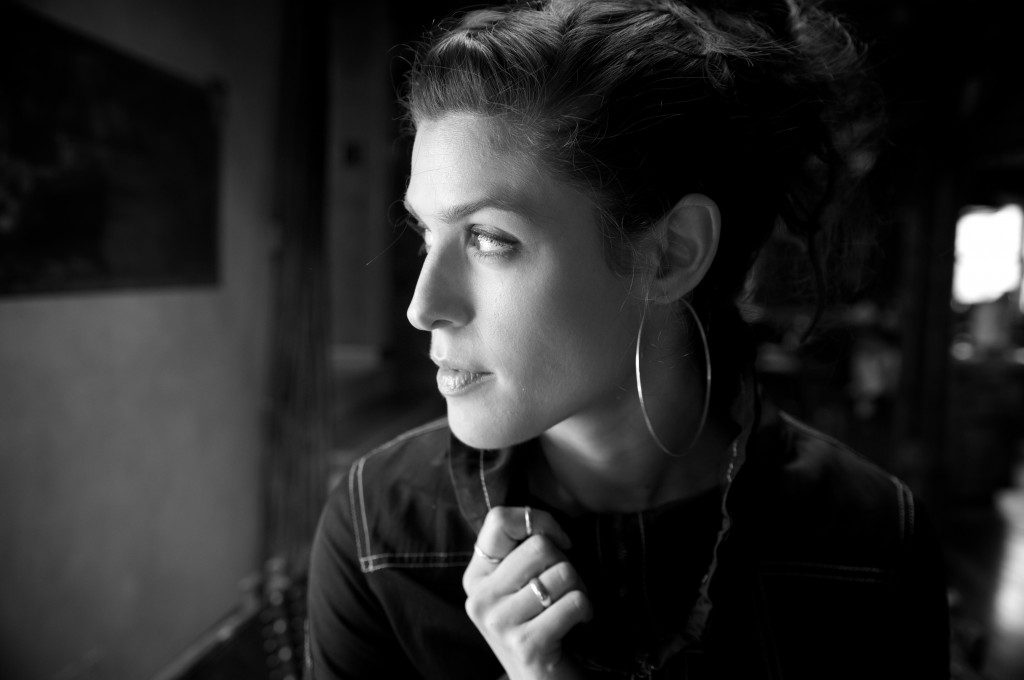
Dessa (photo: Kai Benson)
Interview by Malcolm Lasky
Dessa is a rapper, poet and tiny-book enthusiast who is part of the Doomtree Collective out of Minneapolis, MN. She’s been around the underground music scene for more than a decade now and has three full-length albums out on the collective’s Doomtree Records, as well as a book of poetry and essays entitled Spiral Bound. Rice and Bread recently caught up with her on tour in Philadelphia.
You put out a story called Are You Handsome? with the deluxe version of your album Parts of Speech last year. How that was composed? Because it’s the first book I’ve seen where the design and size of the book are sort of… storytelling techniques.
Dessa: Well, initially I had written it on regular paper. Well, like a word processor. What I did was I justified right everything said by the female character and justified left everything said by the male character. Then the challenge was to relay that spoken attribution in a book, because there wasn’t really enough room to make that little justifying trick work. So we decided to make the colour coding to help make that clear. I worked with a designer named Kai Benson. He’s really good. He’s in Minneapolis and we work together on a lot of stuff.
You talk about not having a lot of agenda in your music, which is interesting, but how did the song “The Bullpen” come into being, because it comes off very…
Agenda-y? Well, I think probably my deeply held beliefs will surface in my music because those are the things that move and inform my life, but I’m more interested in making compelling, expressive, true songs and letting my fundamental views surface naturally than I am in making a mission statement and writing songs that speak to those bullet points.
The way I’ve found to describe your music is that you’re feminist-y in the way that the movie Winter’s Bone is. It’s not like Wonder Woman, “I am a woman, hear me roar” sort of stuff. It’s more like being a well-written character who happens to be a woman just getting stuff done.
I think short term I understand why there’s an urge to compensate and portray female characters as stronger and larger than life, but long term I don’t find it to be a particularly interesting objective. I think we’re better served by telling true stories of women and trusting men and women to see the humanity in them than to write stories about Wonder Woman or to pedestal-ize or romanticize the female condition.
Switching gears a bit here. You’ve toured pretty much everywhere. Are there certain restaurants that you like to frequent on tour
Yeah, they’re not very foodie though. One of the big struggles of being on the road is that you don’t get to do a lot of your eating sitting down. Like, right now I’m eating hummus and cashews backstage. Not a lot of food is warm on tour. That said, I think my objective is “do no damage.” So right now I’m eating a lot of Subway because it’s calorically appropriate to someone who’s sitting in a van for half her life. We also eat at Chipotle a lot because I like the care that they take in sourcing their ingredients, as compared to other fast-food restaurants. On our second-to-last tour I interviewed Michael Pollan, who wrote the book The Omnivore’s Dilemma, and I think a lot about how food is sourced, but it’s tough to live those ideals under a time crunch and a budget constraint.
Dessa (photo: Elli Rader)
What about when you’re home? Is there stuff you like to cook?
Mmm, yeah. I cook a lot when I’m home. I make a lot of farro.
Yeah, I like farro.
Yeah, farro’s good! I cook a lot with at least a couple local ingredients, not entirely local, because I probably don’t have the culinary chops for that. I cook with a lot of mushrooms and carrots and root vegetables, and they’re grown nearby, which I like, and I buy the local cheese.
So why Dessa, as a name, instead of your given name?
I’ve gone by it since I was a teenager, when I was singing at karaoke bars, underage [laughs].
What’s next for you after this tour?
I have my debut at Orchestra Hall when I get back. I wrote my first piece for a really large choir, which is called “The Good Fight,” and that’ll be next month.
How does one write a choir?
I just did it in garage band; I just sang all the parts and then I worked with a great arranger to help me notate all that and give it to them in sheet music form, because I don’t read music.
On your last album, you did a cover of Bruce Springsteen’s “I’m Going Down,” which, I gotta be honest, “Dessa” and “heartland rock” are not two things I would associate with each other. How did that come about?
I think we once had to play a really long set and we decided to do a cover tune, and I really like doing cover tunes that re-establish an emotional center; when you listen to a song that used to be happy and now it’s sad, or vice-versa, I like that, that chameleonic effect of a cover. So we decided to do that one only because I liked it as a kid; I had a friend who used to listen to it when I was 10 and it came to mind. We gave it a go and liked how it came out.
I’ve always been fascinated by how poetry and especially rap share a lot of the same characteristics. I was wondering if you’d ever thought of doing a poem as a song, like, not one of yours.
Yeah, I haven’t. I think deciding how and where to phrase things is so much a part of the songwriting process that it never occurred to me to set someone else’s text to music.
Dessa‘s most recent album, Parts of Speech was released on Doomtree Records in 2013.


No Comments