


By Greg Pratt and Jason Schreurs
When Carcass released their fourth album, Heartwork, in 1993 it surprised, shocked, and divided death metal fans: those who liked their earlier, more gore-drenched and grindcore-focused albums dismissed it as a sellout, the result of a wacky distribution deal Earache struck up with Columbia. Others thought it was great death metal subtly sneaking into the mainstream, taking traditional rock song structures and playing them through a death metal lens.
Years later, it seems that opinion has shifted more toward the latter, but whatever the general longhair populace thinks is of no concern to us: we think Heartwork is a Classic Platter, through and through; the result of musicians blossoming into fully raging metal machines, the songwriting skills amazingly classy and concise for a death metal band, the songs not just wormed into our brains forever but also still on regular rotation, all these years later.
Greg: Well, Carcass’ Heartwork… what do you say? God, it’s sooo good! Carcass are one of my favourite metal bands ever, one of my favourite bands ever, period. But this album was, at the time, considered to be their sellout album by a lot of people. I remember lots of death metal people calling it their “Megadeth” album, because it wasn’t super grinding or anything, and it had catchy songs, and it was kind of mid-tempo, and it was kind of rocking death metal. But, to me, it’s just this perfect amalgamation of Carcass sounds.
Jason: You’re right. I remember the Carcass diehards fans just hating it at the time; the gore-grind crew just weren’t into it. But I think it’s one of the best metal albums of all time, because it combines so many styles of metal and makes them work somehow. I was thinking about how you and I have a totally different experience with this album though, because I wasn’t into death metal anymore when I first heard this album. I had pretty much gotten out of death metal after I had listened to the first wave, then I quit listening to it. But I heard this Carcass album and it brought me back. I was like, “Whoah! This is what death metal is now?!” And I was super stoked. But I know that you were deep in the death metal scene around this time, listening to the Morbid Angels, and the Deicides, and all of that, so you were coming more from being into the extreme stuff, and then hearing this album, which definitely is a lot more of a rocking death metal style.
Greg: When it came out in 1993, I was still a teenager, so I was just into anything that was death metal. It was all good to me. Nocturnus? Sure. Jungle Rot? Bring it on. It was all good. So, to me, this album wasn’t too drastically different, and maybe I was a bit too young to grasp it at the time. It was just an awesome Carcass album that had songs that I could remember and rock out to.
Jason: I had only really heard the first Carcass album and just shrugged them off as a Napalm Death ripoff and never paid attention after that, so I never heard their other earlier albums until after I heard Heartwork, and I had to trace it back. But I just remember being super impressed with the album and thinking, “Oh, this is where death metal is now? This is insane. It’s so melodic and it’s definitely not the death metal I remember.”
Greg: The word that always comes to mind with Heartwork for me is “classy.” It’s a very classy, mature death metal album, but not cheese-ball or anything. It has great songwriting. And it has great solos! And I never say that, because I’m not a guitar solo guy or anything, but it has just killer solos. It’s awesome.

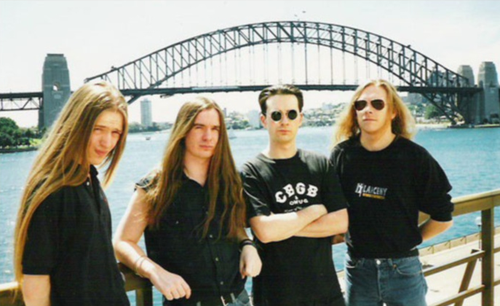
One of the few Carcass band photos from that era.
Jason: Do you think this album was the start of melodic death metal, and all of these bands that you hear about now that, for better or worse, have taken over the metal scene? Was Heartwork the beginning of all of that?
Greg: Yeah, it was definitely one of the first albums that put all of those elements together. You had At the Gates’ Slaughter of the Soul and you had Heartwork, so those were definitely two of the big, early albums where people were saying it was something new and exciting. And then the 2,000 other bands that were nowhere near as good that came after. No one ever matched this album, really. And when you put it on, the first couple of songs are great, then you have “No Love Lost” and the title track as songs three and four. It’s one of those albums where it’s like, “Holy fuck! Hit after hit after hit!” Every song on the first half of the album is just phenomenal. And the title track, man, what an amazing song!
Jason: Yeah, that title track is one of the perfect metal songs. I like “No Love Lost” a lot, too, but when “Heartwork” kicks in, it’s like, “This is metal! This is how it should be.” And you’re going to kill me for this, but a lot of times I would just listen to the first four songs and then turn it off. It would have been the perfect four-song EP, but the second half of the album is really good, too. It’s just those first four songs are just so good.
Greg: I actually do that a lot as well with this album. I get through the first four songs and then I’ll just turn it off. I don’t know if this is something that we all do [laughs], but I do it a lot, because, like you said, those first four songs are just so good. It’s a great album in that sense, because the first half is these great songs that we all know and love, but when you look at the second half it’s confusing which songs are what, but you put it on and it all makes sense. It’s like, “Oh yeah, that song with the most amazing riff ever,” or “Blind Leading the Blind,” which has that huge groove in it. But you look at the song titles and you’re thinking, “I don’t know what’s on the second half of Heartwork,” but then you put it on and it’s hit after hit.
Jason: Were you surprised that with their new one, Surgical Steel, that they were able to almost match Heartwork, with at least the pacing of it and the overall quality of the album? It was definitely up there with Heartwork; it may not be quite as good, but it’s in the running.
Greg: Yeah, it’s definitely up there, but you can’t really compare anything to Heartwork. Carcass are one of these bands… and we’ve talked about this before with bands like Slayer and Faith No More, but when you release an album that’s amazing and perfect, how do you ever live up to it? So that last Carcass album, Surgical Steel, I thought it was great and I was super impressed with it, but still, now that a bit of time has passed, when I want to put on a Carcass album, I’ll go back to Heartwork or Necroticism, if I’m in a bit of a heavier mood. But Carcass did come back on that last album with a grace that most bands do not have, that’s for sure.
Jason: Should we talk about the album that came after Heartwork? I know that was a big bone of contention for a lot of fans as well. We all expected Heartwork part two, I guess, or maybe a return to their earlier stuff, and what we got was something different in 1996’s Swansong.
Greg: I’m the kind of guy who spends a lot of time thinking about death metal history, and Swansong is a fascinating, weird little oddity. Here you have a death metal band who broke through and Heartwork comes out on Earache/Columbia, and they’re getting video play, and there’s these really Megadeth-gone-death-metal song structures and stuff. And then the next album is Swansong, and it opens up with “Keep on Rotting in the Free World,” which is a great song, but it’s like kind of like boogie rock, and everyone was like, “What the hell is this?!” But Swansong is nowhere near as bad as we all remember. I still listen to it now and again. It’s just not that great; that’s its biggest downfall. But it’s not like it’s an album of Molly Hatchet covers or anything; it’s still pretty heavy and stuff. It’s just not as powerful, or something, as Heartwork. But the thing I love about Carcass is they just don’t care. They have a sense of humour and they have a good time, and they don’t take themselves too seriously. And that’s what I love about Swansong. It’s a fun death metal album, and that’s a rare thing.
Jason: There’s not as much fun on Heartwork; it’s a pretty serious album. I remember the first time I saw the album art. I used to own a record store and someone had brought it in on cassette for trade, and I remember looking at it and I thought, “Oh yeah, Carcass. I remember those guys. They’re a Napalm Death ripoff band,” because I didn’t really care about them at the time. And I threw on this tape and started looking at how slick it all was; the cover looks so pro and fancy. I really think this might have been one of the first extreme metal albums that really presented itself in such a professional way, with the packaging, and the artwork, and even the way it’s put together, with the production sound. It was taking metal to a whole new level.
Greg: Yeah, especially for death metal to have such a facelift. And the cover art was part of what death metal purists didn’t like about it, because the earlier Carcass album covers were so gory and stuff, and this one was not. But that’s neat. That’s what a band should do; surprise you with each album. And Carcass have always done that. I guess the only setback with Surgical Steel was that it was exactly what I was hoping for, but it didn’t surprise me at all. And pretty much with every album of their first five, Carcass always surprised me, which I like.
Another rare photo of Carcass during the Heartwork era.
Jason: We can’t talk about this album without talking about Ken Owen and his drumming. This guy is amazing and it’s so unfortunate that he’s not able to drum the same way that he used to, because of his physical challenges. But on this album, this guy was just on fire. It’s one of the most ultimate drumming albums.
Greg: And very unique. Owen always had this sort of sloppy, clumsy style. His drum fills never quite… I’d be like, “Ahh, what are you doing?” But it sounded great. I might be off here, but it sounds like a guy who doesn’t fully know what he’s doing just winging it. Just winging it and doing an awesome job, and coming away with a really unique style because of that. I love listening to him on this album. All of the players on here are really, really good at this point in their career, and they’re really working together nicely. And great songwriting, too. On their album before this, Necroticism, every song was six or seven minutes long. And on this album it was stripped down to three-and-a-half-minute, four-minute song structures. It’s pretty wild.
Jason: I’m just looking at the track listing here and “No Love Lost” is 3:22. That’s shorter than a Britney Spears song. That’s a pop-song length. [Laughs] It’s awesome. Heartwork is right up there with the great albums of metal. We don’t talk about Carcass as being in the same league as the Slayers and Metallicas, but really they are; it’s just that they haven’t done as much stuff. But they had this nearly perfect album that came out at a time when I didn’t really care about death metal. It was tired to me, and I lost interest and stopped paying attention, and this album brought me right back. Then, of course, I’m going back and listening to Cannibal Corpse or Deicide or whatever, and it was like opening death metal back up for me. And the opposite probably happened for a lot of folks, where they maybe listened to Heartwork and were like, “This isn’t death metal. I’m just going to go and listen to a Pungent Stench album” or whatever.
Greg: Wow, good reference there. Yeah, this came out in 1993 and death metal had a huge boom and bust in 1991 or 1992, and there was just so much death metal and every label was just pumping it out. And there was so much generic death metal, so it was neat seeing bands doing something different. By this point, a lot of real hardcore death metal fans were like, “I don’t like all of this generic death metal, and I don’t like Carcass trying to write rock songs, so I’m going to start listening to black metal now.” But I think taking the death metal sound and doing something different with it was exactly what needed to happen in 1993. And it’s just amazing what Carcass came up with on Heartwork.
Carcass‘ Heartwork was released in 1993 on Earache/Columbia.




No Comments